Have you ever wondered how your phone "knows" what the weather is, or how the Uber app knows exactly where your driver is?
The secret is something called a RESTful API. It sounds like a mouthful, but in 2026, it’s just the standard way computers have a polite conversation. To understand it, just imagine you are at your favorite diner.
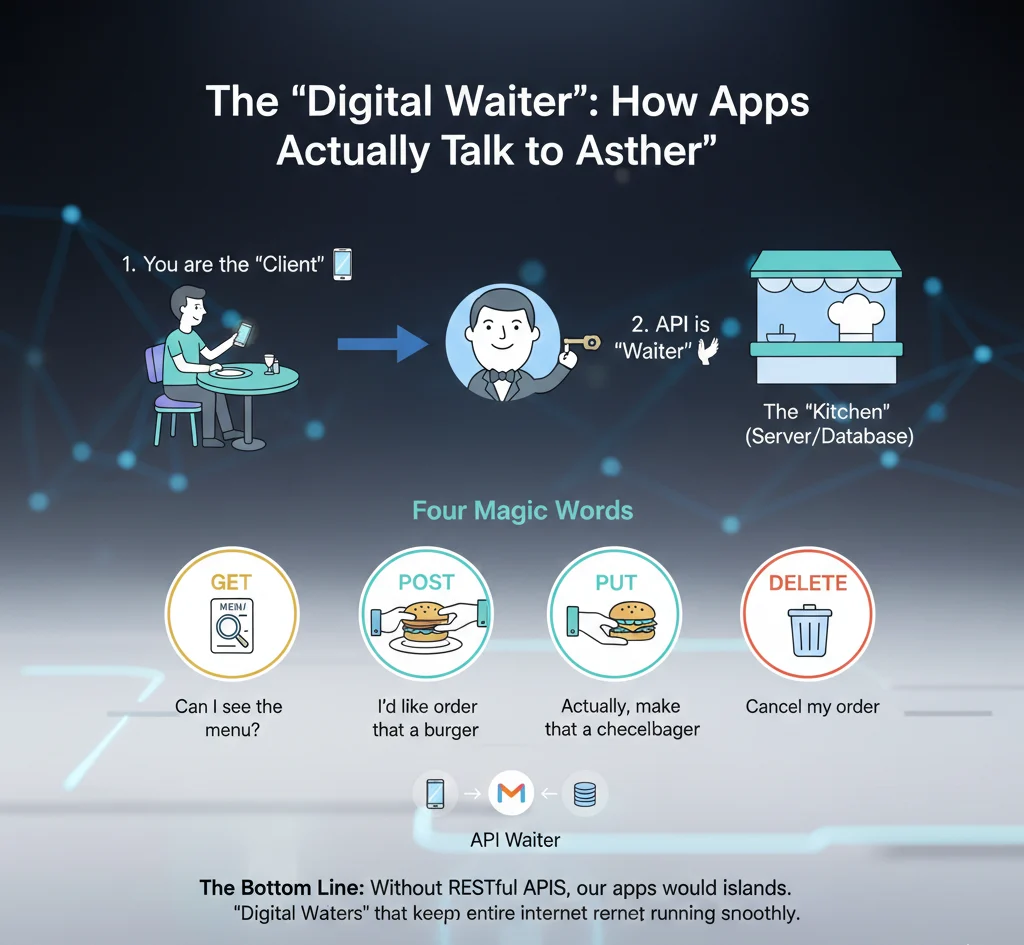
1. You are the "Client"
When you sit down at a table, you are the Client. You have a goal: you want a grilled cheese sandwich. However, you aren't allowed to just walk into the kitchen and start cooking. You need a middleman.
2. The API is the "Waiter"
The API (Application Programming Interface) is your waiter.
You give the waiter your order.
The waiter takes that order to the Kitchen (the Server/Database).
The kitchen prepares your food.
The waiter brings the plate back to your table.
A "RESTful" API is just a waiter who follows a very specific, organized rulebook so there are never any misunderstandings.
3. The "Four Magic Words" of REST
In a RESTful system, the "Client" only uses four main commands to talk to the "Waiter." These are known as HTTP Methods:
GET ("Can I see the menu?"): You are asking for information. You aren't changing anything; you just want to see what’s available.
POST ("I’d like to order a burger"): You are sending new information to the kitchen to create something that wasn't there before.
PUT ("Actually, make that a cheeseburger"): You are updating something that already exists. You’re replacing your old order with a new one.
DELETE ("Cancel my order"): You are asking the kitchen to remove your request entirely.
4. Why "RESTful" is So Popular
The "REST" style is the world’s favorite because it’s Stateless.
This is a fancy way of saying the waiter doesn't need to remember your name or what you ordered yesterday to help you today. Every order (request) stands on its own and contains all the info the kitchen needs. This makes the system incredibly fast and hard to break.
Conclusion:
Without RESTful APIs, our apps would be islands. They wouldn't be able to share data, process payments, or show us live maps. They are the "Digital Waiters" that keep the entire internet running smoothly behind the scenes.