The Illusion of Direct Control
In modern distributed systems, webhooks are the glue that binds disparate services. We rely on them for everything from Stripe payment confirmations to GitHub CI/CD triggers. However, many engineering teams treat webhooks as internal, trusted signals rather than untrusted, external inputs. This 'trust deficit' creates a massive attack surface: if an attacker can spoof a webhook or replay a legitimate one, they can potentially trigger unauthorized state changes, such as marking an unpaid order as 'Completed' or bypassing subscription checks.
Engineering a production-grade webhook consumer requires moving beyond a simple POST endpoint. It demands a multi-layered defense strategy focusing on cryptographic integrity, temporal validity, and operational idempotency.
The Vulnerability: Spoofing and Side-Channels
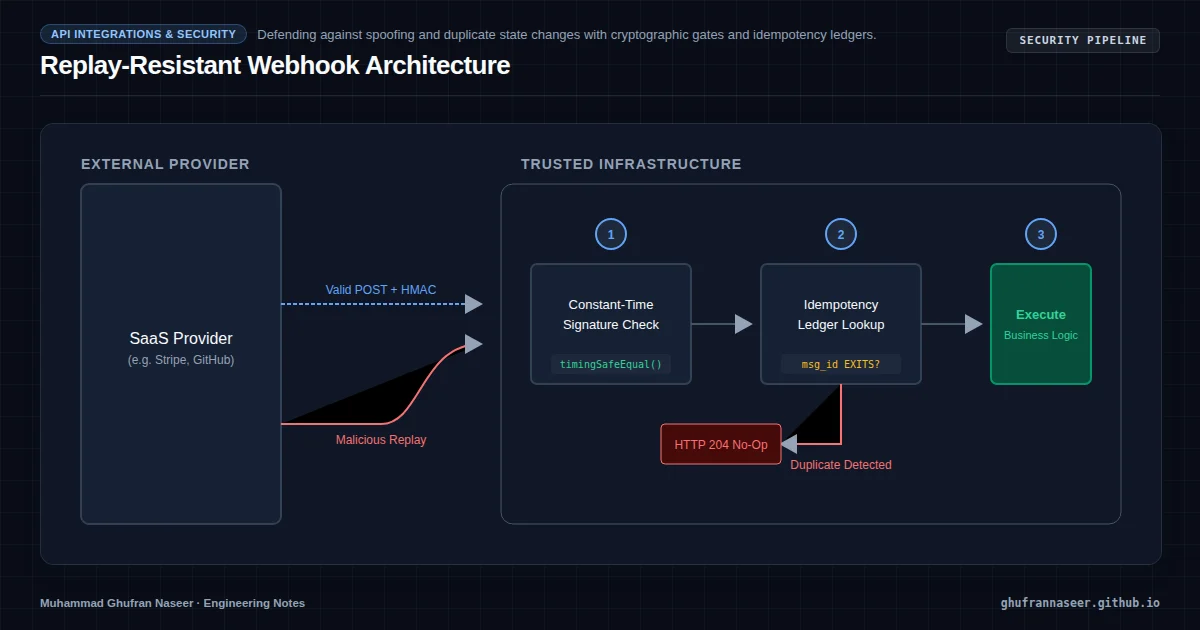
The first line of defense is verifying that the request actually came from the claimed provider. Standard practice involves an HMAC (Hash-based Message Authentication Code) signature sent in a header (e.g., X-Hub-Signature or Stripe-Signature). However, a common mistake is using a standard string comparison to verify this hash.
The Timing Attack Risk
Using a simple if (receivedHash === computedHash) comparison is vulnerable to timing attacks. Because standard string comparison functions return false as soon as they find a mismatch, an attacker can measure the time it takes for your server to respond and eventually brute-force the signature character by character. To mitigate this, we must use a constant-time comparison function.
const crypto = require('crypto');

function isValidSignature(payload, signature, secret) {
  const expectedSignature = crypto
    .createHmac('sha256', secret)
    .update(payload)
    .digest('hex');

  // Prevents timing attacks by comparing all bytes regardless of match
  return crypto.timingSafeEqual(
    Buffer.from(expectedSignature),
    Buffer.from(signature)
  );
}
The Replay Attack: When Valid Requests Become Malicious
Even with perfect signature verification, your system is still vulnerable to Replay Attacks. An attacker can intercept a valid, signed webhook request and resend it to your server multiple times. Since the signature is technically valid (it matches the payload), your server will process it again.
Imagine a webhook that grants a user 100 credits. Replaying that request 50 times could grant 5,000 credits without a single cent being paid. To prevent this, we must implement a Temporal Tolerance Window. Most reputable providers include a timestamp in the signature header. Your server must verify that the timestamp is within a reasonable window (e.g., +/- 5 minutes) to account for clock drift while rejecting stale requests.
Architecting for Idempotency
Beyond security, webhooks are inherently flaky. Network issues can cause providers to retry a webhook multiple times, even if your server already processed it successfully. If your logic is not idempotent, these retries will cause data corruption or duplicate side effects.
The 'Insert-Only' Ledger Pattern
The most resilient way to handle this is by tracking the unique Event ID provided by the third party. Before processing any business logic, check if you have already seen this specific ID. A common anti-pattern is checking the status of an object (e.g., if (order.status !== 'paid')), which is prone to race conditions. Instead, use a unique constraint in your database.
| Strategy | Implementation | Benefit |
|---|---|---|
| Database Constraint | UNIQUE(provider, event_id) | Hard stop for duplicates at the storage layer. |
| Idempotency Table | INSERT INTO processed_webhooks... | Decouples business logic from event tracking. |
| Atomic Transactions | BEGIN...COMMIT | Ensures state changes and event logging succeed or fail together. |
-- SQL structure for a robust idempotency log
CREATE TABLE webhook_idempotency (
    id UUID PRIMARY KEY DEFAULT gen_random_uuid(),
    provider_event_id TEXT NOT NULL,
    provider_name TEXT NOT NULL,
    processed_at TIMESTAMP WITH TIME ZONE DEFAULT NOW(),
    UNIQUE(provider_name, provider_event_id)
);
Operationalizing the Webhook Pipeline
A senior engineer knows that processing heavy business logic directly inside the webhook request handler is a recipe for disaster. If your processing takes 15 seconds, the provider might time out and retry, leading to a backlog. Instead, the handler should only perform three tasks:
- Verify the cryptographic signature (Timing-safe).
- Verify the timestamp (Replay protection).
- Enqueue the raw payload into a message broker (like RabbitMQ or SQS) and return a
202 Acceptedimmediately.
This decouples the *reception* of the event from the *execution* of the logic, allowing you to use Dead Letter Queues (DLQ) to handle failed jobs without losing the original webhook data.
Closing Takeaway
Webhooks are not just simple API endpoints; they are asynchronous trust boundaries. To build a production-grade integration, you must assume the network is hostile and the provider is unreliable. By enforcing constant-time signature verification, strict temporal windows, and database-level idempotency, you transform a fragile integration into a resilient, secure system component.