The Illusion of Constant Performance
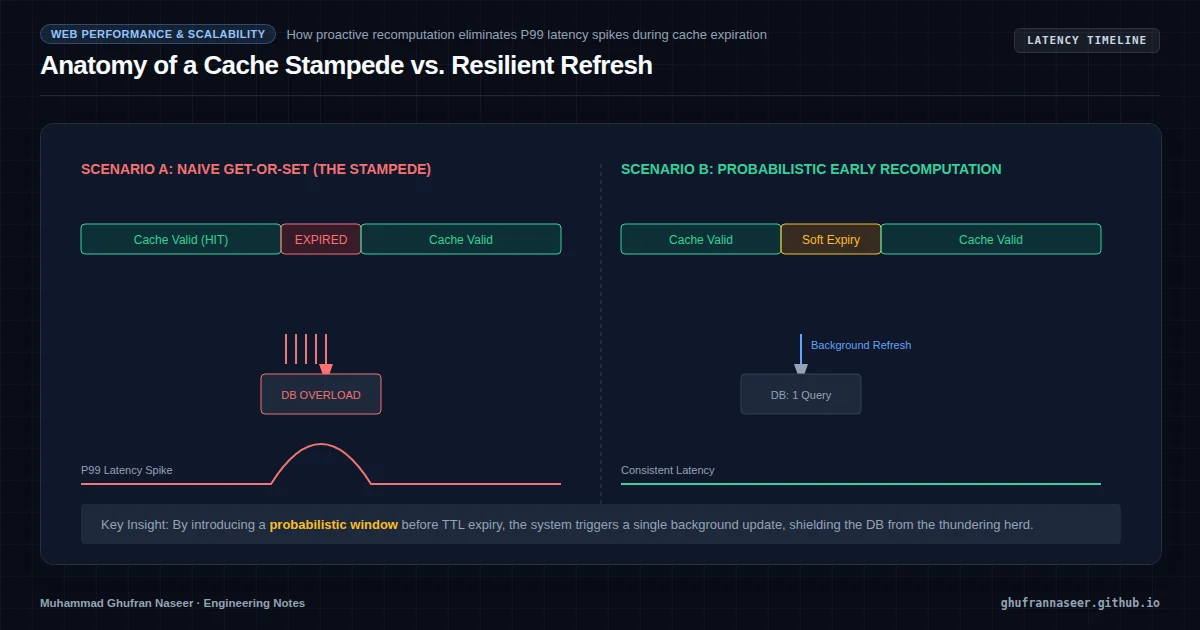
In the world of high-traffic web engineering, we often rely on caching layers like Redis or Memcached to mask heavy database operations and complex computations. We celebrate our sub-50ms response times and high cache-hit ratios. However, many systems suffer from a hidden pathology known as the 'Tail-Latency Trap.' This occurs when a high-traffic cache key expires, causing a sudden surge of concurrent requests to hit the origin database simultaneously. This is the Cache Stampede, also known as the Thundering Herd problem.
The Anatomy of a Stampede
Consider a product detail page for an e-commerce site receiving 500 requests per second. The data is cached with a 60-second TTL (Time-To-Live). At second 61, the cache expires. For the few hundred milliseconds it takes for the first request to fetch data from the database and re-populate the cache, dozens or even hundreds of other incoming requests find the cache empty. They all proceed to query the database.
The result? A massive spike in P99 latency, database connection exhaustion, and potentially a cascading failure across the microservices mesh. The system isn't 'slow'—it's inconsistently fast, which is often more dangerous for user experience and Core Web Vitals like LCP (Largest Contentful Paint).
The Anti-Pattern: Simple Get-or-Set
Most developers implement caching using a naive check-and-fetch pattern. While functional for low-traffic apps, this is the root cause of stampedes.
async function getProduct(id) {
  let data = await redis.get(`product:${id}`);
  if (!data) {
    // Problem: 100 concurrent requests reach here at once
    data = await db.products.find(id);
    await redis.set(`product:${id}`, data, 'EX', 60);
  }
  return data;
}
Engineering Strategy 1: Probabilistic Early Recomputation (PER)
One of the most elegant solutions to the stampede problem is the X-Fetch or Probabilistic Early Recomputation algorithm. Instead of waiting for the TTL to hit zero, the system starts considering a recomputation as the expiration approaches. The closer we get to the expiration, the higher the probability that a request will trigger a refresh.
This ensures that only one (or very few) requests trigger the refresh before the key actually expires, keeping the cache 'warm' without blocking the main thread or overwhelming the database.
function shouldRefresh(ttl, beta = 1.0) {
  const gap = -Math.log(Math.random()) * beta;
  return (Date.now() + gap) > ttl;
}

// Implementation logic:
// Store the 'expiry' timestamp inside the cached value itself.
// If shouldRefresh(stored_expiry) is true, re-fetch even if the key exists.
Engineering Strategy 2: The 'Stale-While-Revalidate' (SWR) Pattern
For systems where slightly stale data (by a few seconds) is acceptable, the SWR pattern is the gold standard. In this architecture, we use a 'Soft TTL' and a 'Hard TTL.' When a request hits a key that has passed its Soft TTL but is still within its Hard TTL, the system returns the stale data immediately and triggers an asynchronous background worker to refresh the cache.
This completely decouples the user-facing latency from the database fetch time. The user always gets a fast response (from cache), and the database load is controlled by a background process that can be throttled or debounced.
Engineering Strategy 3: Promise Memoization and Locking
If you cannot afford stale data, you must implement Request Collapsing. In this model, if multiple requests for the same key arrive simultaneously while the cache is empty, only the first request is allowed to hit the database. The subsequent requests 'wait' for the first one to finish and then consume the same result.
| Strategy | Latency Impact | Complexity | Best Use Case |
|---|---|---|---|
| Naive TTL | High (at expiry) | Low | Low traffic / Internal tools |
| Probabilistic (PER) | Very Low | Medium | High-traffic read-heavy APIs |
| SWR (Background) | Zero | Medium | Product catalogs, CMS content |
| Request Collapsing | Medium | High | Strict consistency requirements |
Operational Considerations: Payload Budgeting
Beyond the frequency of fetches, the size of the cached payload directly impacts performance. Large serialized JSON blobs in Redis can block the event loop during deserialization. As a Senior Engineer, you should enforce a Payload Budget. If a cached object exceeds 100KB, consider:
- Field Filtering: Only cache the fields required for the specific view.
- Compression: Use Brotli or Zstd for large strings before storing in Redis.
- Normalization: Store IDs and fetch hydration data from a local-node L1 cache.
Conclusion: Consistency is the New Speed
In 2026, raw speed is easy; consistent speed is the real engineering challenge. By moving away from naive TTLs and adopting probabilistic refreshes or SWR patterns, you eliminate the latency spikes that degrade user experience and destabilize infrastructure. A resilient system doesn't just handle the load—it handles the transitions between states without breaking a sweat.