The Silent Killer of Enterprise Systems: Inventory Drift
In the world of Enterprise Resource Planning (ERP) and Property Management Systems (PMS), there is a specific type of failure that keeps senior engineers awake at night: Data Drift. It doesn't manifest as a 500 error or a crash. Instead, it’s a silent discrepancy where your database says you have three units in stock, but the physical shelf—and the customer's frustration—says you have zero.
This usually happens because developers treat state transitions as simple arithmetic operations rather than atomic business events. When two concurrent requests attempt to decrement a value at the exact same millisecond, the classic Read-Modify-Write cycle breaks. If you are building systems meant to scale beyond a single user, you cannot rely on the 'luck' of low traffic.
The Fallacy of Simple Updates
Consider a standard Express/Node.js handler for an order placement. A common, yet flawed, implementation looks like this:
// ANTI-PATTERN: The Read-Modify-Write Race Condition
const product = await db.products.findOne({ id: productId });
if (product.stock >= quantity) {
  const newStock = product.stock - quantity;
  await db.products.update({ id: productId }, { stock: newStock });
  await createOrder(userId, productId, quantity);
}
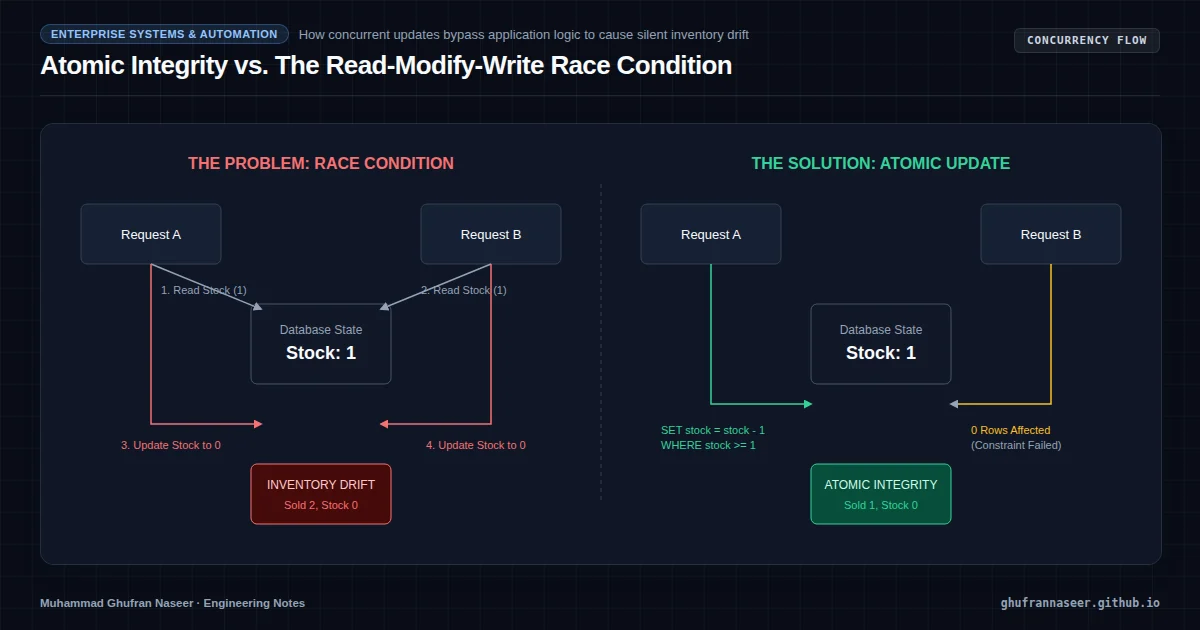
In a high-concurrency environment, two threads can read the same product.stock value simultaneously. Both see '1' unit available, both calculate newStock = 0, and both successfully update the database. You have now sold two items when you only had one. This is a classic race condition that bypasses application-level logic.
Level 1: Database-Level Atomic Constraints
The first line of defense is moving the logic into the database engine itself. SQL databases are designed to handle concurrency through ACID properties. Instead of calculating the new value in your application code, perform the arithmetic in the UPDATE statement with a WHERE clause.
UPDATE products
SET stock = stock - :quantity
WHERE id = :productId
AND stock >= :quantity;
This ensures that the subtraction only happens if the condition is met at the moment the row is locked. If the UPDATE affects zero rows, you know the stock was insufficient, and you can return a 409 Conflict to the user.
Level 2: Optimistic Locking with Versioning
While atomic updates work for simple counters, complex ERP workflows often involve multiple tables (inventory, ledger, tax, and shipping). For these, Optimistic Locking is a more robust pattern. By adding a version or updated_at column to your records, you can ensure that the record hasn't changed since you last read it.
| Step | Action | SQL / Logic |
|---|---|---|
| 1 | Read Record | SELECT stock, version FROM products WHERE id = 1; (Result: v10) |
| 2 | Process Logic | Calculate taxes, check discounts, verify shipping. |
| 3 | Conditional Update | UPDATE products SET stock = 5, version = 11 WHERE id = 1 AND version = 10; |
If another process updated the record while you were processing, the version would be 11, the WHERE clause would fail, and your application would catch the failure to prevent inconsistent state.
Level 3: Moving from State to Ledgers (Event Sourcing Lite)
The most resilient enterprise systems do not treat inventory as a single number. They treat it as a Ledger. Instead of updating a stock column, you append rows to a stock_transactions table. The current balance is simply the sum of all transactions.
"State is a snapshot; the ledger is the truth."
By using a ledger, you gain a built-in audit trail. If a customer asks why their order was canceled, you don't look at a static '0'. You look at the transaction history to see exactly which processes claimed the stock and when. To maintain performance, you can use a 'Materialized View' or a cached 'Snapshot' table that is updated via database triggers or background workers.
The Idempotency Challenge in Background Queues
On constrained servers (like a 2GB RAM VPS), you can't just throw more hardware at the problem. You need efficient background processing. However, background jobs (using BullMQ, Sidekiq, or RabbitMQ) often retry on failure. If your 'Deduct Inventory' job retries three times due to a network flicker, you risk deducting the stock three times.
To solve this, implement Idempotency Keys. Every transaction should be linked to a unique request_id or idempotency_key (usually a UUID generated by the client or the gateway). Before processing, check if a transaction with that key already exists.
// Idempotent Transaction Handler
await db.transaction(async (tx) => {
  const existing = await tx.ledger.findUnique({ where: { idempotency_key: key } });
  if (existing) return existing;

  const entry = await tx.ledger.create({
    data: { amount: -1, type: 'SALE', idempotency_key: key }
  });
  return entry;
});
Handling Distributed Failures: The Transactional Outbox
A common failure mode occurs when you update your database but fail to notify an external service (like an email provider or a third-party logistics API). If the database commit succeeds but the network call fails, your systems are out of sync.
The Transactional Outbox Pattern solves this by writing the 'event' to a dedicated outbox table within the same database transaction as the business logic. A separate, lightweight background process polls this table and ensures the external message is sent at least once.
- Atomicity: The business change and the 'event' to notify others succeed or fail together.
- Resilience: If the external API is down, the outbox processor retries until it succeeds.
- Order: Events are processed in the order they were created.
Summary: Engineering for the "Worst Case"
Building for enterprise scale requires moving away from the "Happy Path." When designing systems that manage value—whether it is physical inventory, financial credits, or booking slots—always assume that multiple actors will attempt the same action simultaneously.
By implementing atomic updates, optimistic locking, and idempotent ledgers, you transform a fragile system into a predictable one. The goal isn't just to make it work; it's to make it impossible for it to fail silently.