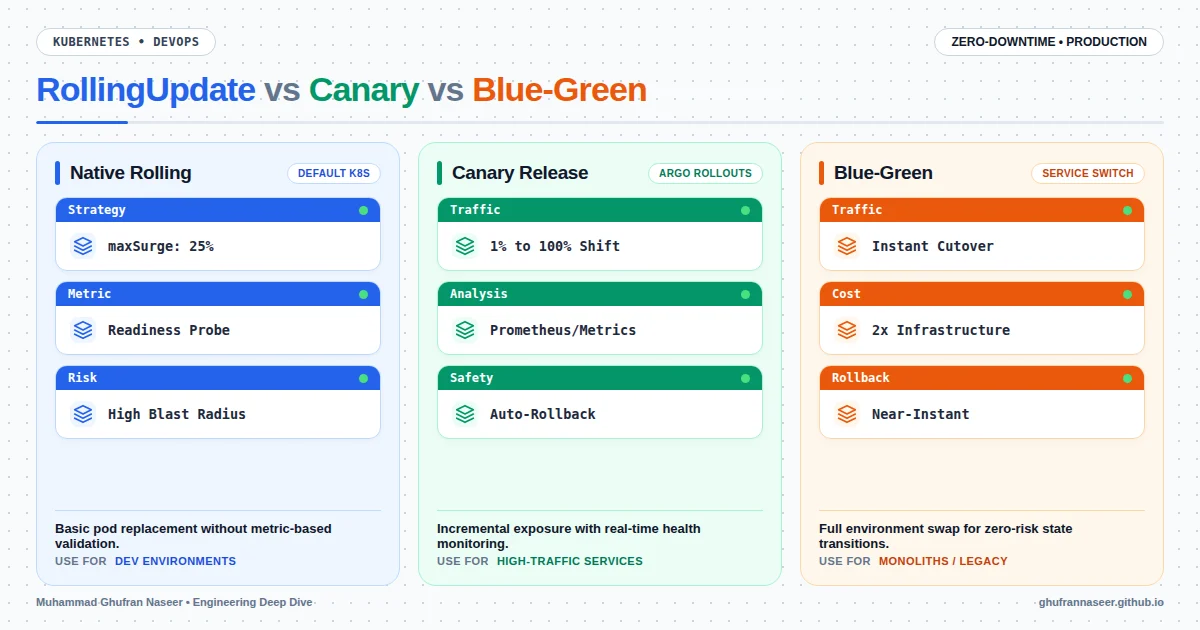
In the modern landscape of distributed systems, the metric that defines engineering excellence is no longer just how fast you can ship code, but how safely you can deploy it. For many teams, the Kubernetes RollingUpdate strategy is the default, yet it often falls short in production environments where a single misconfiguration or a latent memory leak can bypass basic readiness probes and trigger a site-wide outage. When your deployment process relies on "hope" as a strategy, you are one YAML change away from a 2:00 AM incident call.
Progressive Delivery is the evolution of Continuous Delivery that introduces fine-grained control over traffic shifting and automated feedback loops. By decoupling the deployment (the act of installing the software) from the release (the act of exposing it to users), engineers can validate new versions against real-world traffic with minimal blast radius. This article explores the architectural patterns and tooling required to move from basic rollouts to industrial-grade progressive delivery pipelines.
1. The Limitations of Native Kubernetes Rolling Updates
Standard Kubernetes deployments use a RollingUpdate strategy by default. While effective for simple state transitions, it possesses three critical flaws that lead to production instability:
- Lack of Real-Time Validation: Kubernetes only checks if a container is "ready" (Liveness/Readiness probes). It does not know if your error rate has spiked or if latency has increased by 200% until it is too late.
- Binary Success Metric: If the pod stays up, Kubernetes assumes the version is healthy. It cannot perform complex analysis of logs or custom Prometheus metrics during the rollout.
- Lack of Traffic Control: You cannot send exactly 5% of traffic to a new version. The traffic distribution is determined by the pod ratio, which is often too coarse for high-traffic environments.
To overcome these, we must implement strategies like Blue-Green or Canary deployments using specialized controllers like Argo Rollouts or Flagger.
2. Comparing Release Strategies: Blue-Green vs. Canary
Choosing the right strategy depends on your application’s statefulness, infrastructure costs, and risk tolerance. The following table highlights the trade-offs between the two primary progressive delivery patterns:
| Feature | Blue-Green Deployment | Canary Deployment |
|---|---|---|
| Traffic Shift | Instant (All-or-nothing) | Incremental (1% -> 10% -> 100%) |
| Resource Cost | High (Requires 2x capacity) | Low (Incremental scaling) |
| Rollback Speed | Near-instant (Router flip) | Fast (Traffic redirection) |
| Best For | Legacy apps, breaking API changes | High-traffic microservices, UI updates |
| Complexity | Low to Moderate | High (Requires Service Mesh/Ingress) |
3. Implementing Canary Releases with Argo Rollouts
Argo Rollouts replaces the standard Deployment object with a Rollout Custom Resource Definition (CRD). It allows for complex "steps" and integration with observability providers to automate the decision-making process. Below is a realistic example of a Rollout spec that shifts traffic incrementally and waits for manual or automated promotion.
apiVersion: argoproj.io/v1alpha1
kind: Rollout
metadata:
  name: payment-gateway
spec:
  replicas: 10
  strategy:
    canary:
      canaryService: payment-gateway-canary
      stableService: payment-gateway-stable
      trafficRouting:
        nginx:
          stableIngress: payment-gateway-ingress
      steps:
      - setWeight: 10
      - pause: { duration: 5m }
      - setWeight: 25
      - analysis:
          templates:
          - templateName: error-rate-check
      - setWeight: 50
      - pause: { } # Manual pause for QA verification
The Role of AnalysisTemplates
The true power of this setup lies in the AnalysisTemplate. This resource queries your monitoring system (Prometheus, Datadog, etc.) during the rollout. If the query returns a value outside the threshold (e.g., HTTP 5xx > 1%), the controller automatically aborts the rollout and redirects traffic back to the stable version, ensuring the blast radius is limited to the initial 10% of users.
4. Solving the Database Migration Dilemma
Zero-downtime deployments often fail not because of the code, but because of the database. When running two versions of an application simultaneously (the old and the new), your database schema must support both. This is known as the "Expand and Contract" pattern:
- Expand: Add new columns or tables. Ensure they are nullable or have defaults so the old code doesn't break.
- Deploy: Roll out the new application version that writes to both the old and new columns.
- Migrate: Run a background job to backfill data from old columns to new columns.
- Contract: Once the old application version is fully decommissioned, remove the old columns.
Engineering Note: Never perform destructive database changes (like dropping a column) in the same deployment phase as an application update. Always separate schema changes from logic changes.
5. Common Operational Mistakes to Avoid
In my experience tuning production clusters, these are the most frequent pitfalls engineers encounter when adopting progressive delivery:
- Ignoring Connection Draining: If your Nginx or Envoy configuration doesn't allow enough time for long-lived connections to close, users will see 502 errors during traffic shifts.
- Missing Resource Requests/Limits: Without proper CPU/Memory limits, a new Canary pod might cause a node to undergo OOM (Out Of Memory) killing, affecting stable pods on the same node.
- Over-Reliance on Manual Promotion: If a human has to click "Approve" for every 10% increment, you haven't built a pipeline; you've built a bottleneck. Aim for automated analysis.
- Ignoring TTL and Caching: DNS-based traffic shifting is notoriously unreliable due to aggressive caching. Always prefer L7 (Application Layer) shifting via Ingress or Service Mesh.
Conclusion
Mastering progressive delivery in Kubernetes is about shifting the engineering culture from reactive firefighting to proactive risk management. By leveraging tools like Argo Rollouts and integrating deep observability into your deployment lifecycle, you create a system that is self-healing and resilient by design.
Remember: Deployments should be a non-event. If your team is cheering after a successful release, your process is likely too risky. Aim for the quiet confidence of automated, metric-driven rollouts.