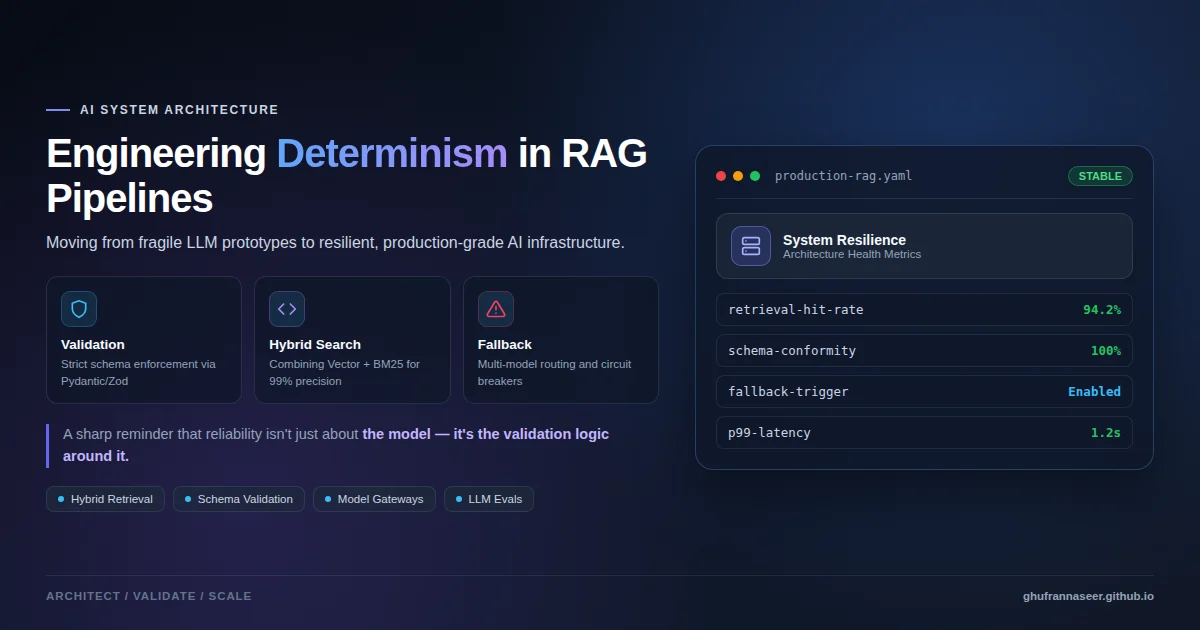
In the early days of the generative AI boom, the industry was captivated by the 'magic' of LLMs. We saw a flood of proof-of-concepts that could summarize documents or answer questions with startling fluency. However, as we move deeper into 2026, the engineering challenge has shifted from 'Can it work?' to 'Can it work reliably at scale?' For the senior software engineer, the non-deterministic nature of Large Language Models (LLMs) represents a fundamental departure from the predictable state machines we have spent decades building. To bring these models into production, we must surround them with traditional engineering rigors: validation, observability, and redundancy.
The most common pattern for grounding LLMs in factual data is Retrieval-Augmented Generation (RAG). Yet, a naive RAG implementation—simply piping vector search results into a prompt—is rarely production-ready. It suffers from retrieval noise, context window saturation, and the 'hallucinated structure' problem where the model fails to return valid JSON. To build industrial-grade AI, we must architect systems that treat the LLM as a high-latency, unpredictable compute kernel that requires strict input/output sanitization and fallback logic.
1. The Retrieval Bottleneck: Beyond Simple Vector Search
Most RAG failures occur before the LLM even sees the prompt. Standard k-Nearest Neighbors (kNN) search in a vector database often returns chunks that are semantically similar but contextually irrelevant. In a production environment, we implement a multi-stage retrieval pipeline to ensure high precision.
Hybrid Search and Re-ranking
Semantic search (embeddings) is excellent for conceptual queries but poor at finding specific identifiers like product IDs or technical acronyms. A production-grade system uses hybrid search, combining vector embeddings with BM25 (keyword) indexing. Once the initial candidates are retrieved, we apply a 'Cross-Encoder' re-ranker. This secondary model evaluates the specific relationship between the query and each chunk, discarding the 'noise' that simple cosine similarity might have missed.
| Search Method | Strength | Weakness | Production Use Case |
|---|---|---|---|
| Vector Search | Conceptual mapping | Poor at exact keywords | General Q&A, Intent discovery |
| Keyword (BM25) | Exact matches | No semantic context | Error codes, SKU lookups |
| Hybrid + Re-rank | High Precision | Higher Latency | Critical Documentation, Legal/Medical |
2. Enforcing Structure: From Strings to Validated Schemas
One of the greatest hurdles in AI automation is the lack of a predictable interface. If your downstream microservice expects a specific JSON schema but the LLM returns a conversational preamble or a slightly malformed string, the system crashes. We solve this by moving away from raw string prompts and toward structured output enforcement.
The Validation Loop Pattern
Instead of hoping the LLM follows instructions, we use libraries like Pydantic or TypeChat to define the expected state. When the LLM responds, the output is passed through a validator. If it fails, the system automatically triggers a 'self-correction' prompt, feeding the error message back to the model to fix its own formatting. This creates a deterministic interface for non-deterministic models.
// Example: Structured Output Validation Pattern
async function getValidatedResponse(prompt, schema) {
  let attempts = 0;
  while (attempts < 3) {
    const response = await llm.generate(prompt, { format: "json" });
    const validation = schema.safeParse(response);
    if (validation.success) return validation.data;

    // Feedback loop: tell the model what it got wrong
    prompt += `\nError: Invalid JSON. ${validation.error.message}`;
    attempts++;
  }
  throw new Error("Max retries exceeded for structured output");
}
3. Resilience through Multi-Model Fallback and Rate-Limiting
Dependency on a single LLM provider is a significant architectural risk. API outages, sudden latency spikes, or model deprecations can take down your entire automation pipeline. A senior engineer designs for 'Model Agnosticism.' This involves implementing a gateway that can route traffic between different providers (e.g., OpenAI, Anthropic, or locally-hosted Llama instances) based on health and cost.
The Circuit Breaker Strategy
We implement circuit breakers at the API gateway level. If the primary high-reasoning model (e.g., GPT-4o) crosses a latency threshold of 5000ms or returns a 429 (Rate Limit), the system automatically falls back to a faster, cheaper model (e.g., Claude Haiku or a fine-tuned Llama 3.1). While the reasoning capability might be slightly lower, the system remains operational, adhering to the 'graceful degradation' principle of distributed systems.
4. The Evaluation Pipeline: Moving Beyond the 'Vibe Check'
You cannot improve what you cannot measure. In traditional software, we have unit tests. In AI, we have 'Evals.' A production RAG system requires an automated evaluation pipeline that runs every time a prompt or a chunking strategy is modified. We use metrics like:
- Faithfulness: Is the answer derived solely from the retrieved context?
- Answer Relevance: Does the response actually address the user's query?
- Context Precision: Were the retrieved chunks actually useful?
Using an 'LLM-as-a-judge' (G-Eval) allows us to run thousands of these evaluations in CI/CD, generating a 'Reliability Score' before any code is merged to main. This transforms prompt engineering from 'guessing' into an empirical science.
5. Engineering Lessons and Common Mistakes
"The biggest mistake engineers make is treating the LLM as a database. It is not a storage layer; it is a reasoning engine. Keep your data in your vector store and your logic in your code."
Common pitfalls to avoid include:
- Over-chunking: Breaking documents into pieces so small they lose all context. Aim for 512-1024 tokens with significant overlap.
- Ignoring Metadata: Not using metadata filters (e.g.,
tenant_id,doc_type) during retrieval, which leads to data leakage across users. - Prompt Bloat: Adding more and more instructions to a single prompt until the model suffers from 'lost in the middle' syndrome.
- Lack of Caching: Re-generating responses for identical queries, wasting both time and money. Use semantic caching to store and retrieve previous LLM responses.
Conclusion
Building for production in 2026 requires us to look past the hype and apply rigorous engineering constraints to AI. By architecting hybrid retrieval pipelines, enforcing structured outputs, and implementing multi-model fallback strategies, we turn fragile demos into resilient industrial systems. Remember: Reliability in AI isn't about the model's intelligence—it's about the architecture's ability to handle the model's unpredictability.