In the vacuum of a local development environment, every application feels robust. You open a form, edit a field, and click save. The database updates instantly. But the moment that application hits production and serves more than one user, a silent killer emerges: the Lost Update Problem. This isn't a bug in your code logic; it is a fundamental architectural flaw in how most full-stack developers handle state synchronization between the client and the server.
The Anatomy of a Silent Data Collision
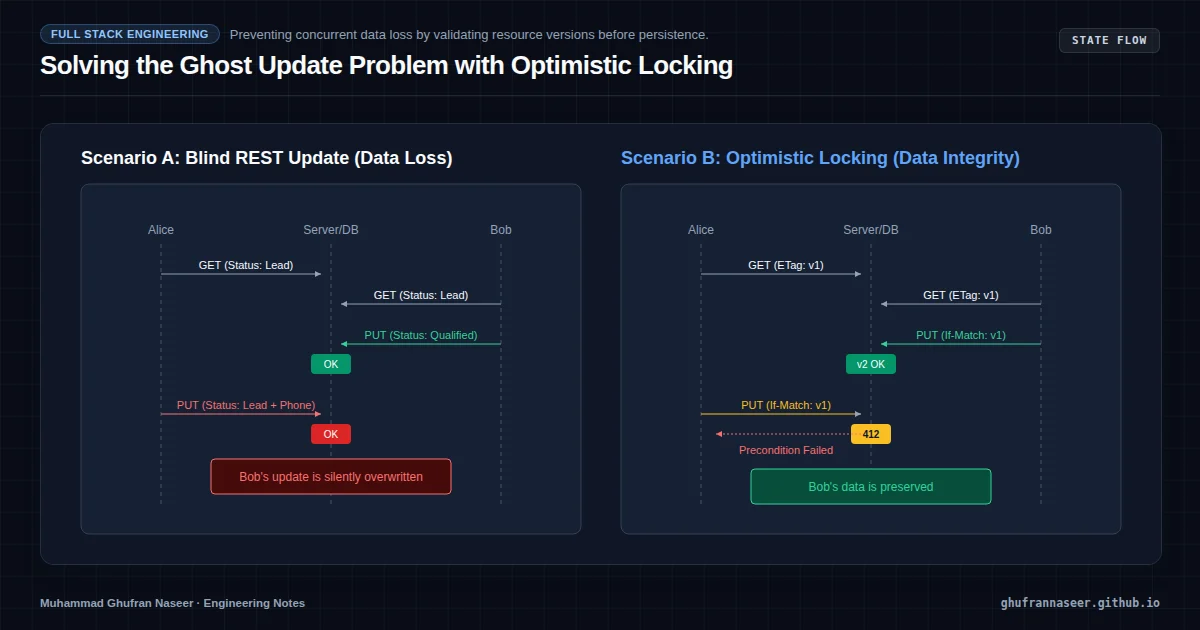
Imagine a CRM system built with Laravel and React. Two account managers, Alice and Bob, open the same client record simultaneously. The record shows the client's status as "Lead."
- Alice edits the client's phone number and prepares to save.
- Bob, meanwhile, changes the client's status to "Qualified" and clicks save. The server updates the record.
- Alice clicks save. Her payload contains the old "Lead" status (because that was the state when she loaded the form) but the new phone number.
The result? Bob’s update to the status is silently overwritten and lost forever. Alice is unaware she just reverted a business-critical status change, and the system has no record of the conflict. This is the "Ghost Update."
Why Standard REST Patterns Fail
Most developers rely on simple PUT or PATCH requests. In a standard Laravel controller, the logic usually looks like this:
public function update(Request $request, Client $client)
{
    $client->update($request->validated());
    return response()->json($client);
}
This code is "blind." It assumes that the version of the resource the client is sending back is the same version that currently exists in the database. In a high-concurrency environment, this assumption is dangerous. We are treating the database as a simple key-value store rather than a source of truth that evolves over time.
Implementing Optimistic Locking with ETags
To solve this without the performance bottleneck of pessimistic locking (locking the database row so no one else can read it), we use Optimistic Locking. The most standardized way to implement this in web engineering is through ETags (Entity Tags) and the If-Match HTTP header.
1. The Backend: Versioning the Resource
First, we must ensure every resource has a unique identifier for its current state. While you can use a version integer column, utilizing the updated_at timestamp or a hash of the model's attributes is often cleaner. In Laravel, we can create a middleware that checks for the If-Match header.
// In a custom middleware: CheckPrecondition.php
public function handle($request, Closure $next)
{
    $resource = $request->route('client'); // Assume route model binding
    $currentEtag = md5($resource->updated_at);

    if ($request->hasHeader('If-Match') && $request->header('If-Match') !== $currentEtag) {
        return response()->json(['message' => 'Precondition Failed: Data is out of date.'], 412);
    }

    return $next($request);
}
2. The Frontend: Managing the Handshake
In the React frontend, when we fetch the data, we must store the ETag. When the user submits the form, we send that ETag back in the If-Match header. If the server returns a 412 Precondition Failed, the frontend knows a conflict has occurred.
async function updateClient(clientId, payload, etag) {
  try {
    const response = await axios.patch(`/api/clients/${clientId}`, payload, {
      headers: { 'If-Match': etag }
    });
    return response.data;
  } catch (error) {
    if (error.response?.status === 412) {
      // Trigger conflict resolution UI
      handleConflict(clientId);
    }
    throw error;
  }
}
The UX of Conflict Resolution
Detecting the conflict is only half the battle. How do we resolve it? There are three primary strategies, each with its own trade-offs:
| Strategy | Implementation | Best For |
|---|---|---|
| Force Overwrite | User is told there is a conflict and chooses "Save Anyway," bypassing the ETag. | Non-critical internal tools. |
| Merge & Re-evaluate | Fetch the new data, merge the user's changes into it, and show the diff. | Complex forms (CRMs, ERPs). |
| Discard & Refresh | Notify the user their data is stale and force a reload of the record. | High-velocity data (Stock tickers, bidding). |
For most enterprise applications, the Merge & Re-evaluate strategy is superior. You present the user with a side-by-side comparison: "Your change: Status = Lead | Current DB: Status = Qualified. Which do you want to keep?"
Scaling the Solution: Background Jobs and Webhooks
The problem deepens when background jobs or third-party webhooks are involved. If a background job updates a client's "last_contacted" timestamp while a user is editing their profile, the ETag will change, and the user's save will fail—even though the fields they edited don't overlap with the background job's changes.
To mitigate this, sophisticated systems move away from global ETags (hashing the whole model) toward Field-Level Versioning or Intent-Based APIs. Instead of sending the whole object back, the frontend sends only the specific fields that changed (PATCH), and the backend validates the version of only those specific columns.
Engineering Takeaway
Statelessness is a feature of the web, but it is a bug for data integrity if not managed correctly. As a Senior Engineer, your responsibility isn't just to make the "Save" button work; it's to ensure that when it works, it doesn't inadvertently destroy someone else's work. By implementing optimistic locking via ETags and 412 status codes, you transform a fragile application into a resilient, production-grade system capable of handling real-world human concurrency.