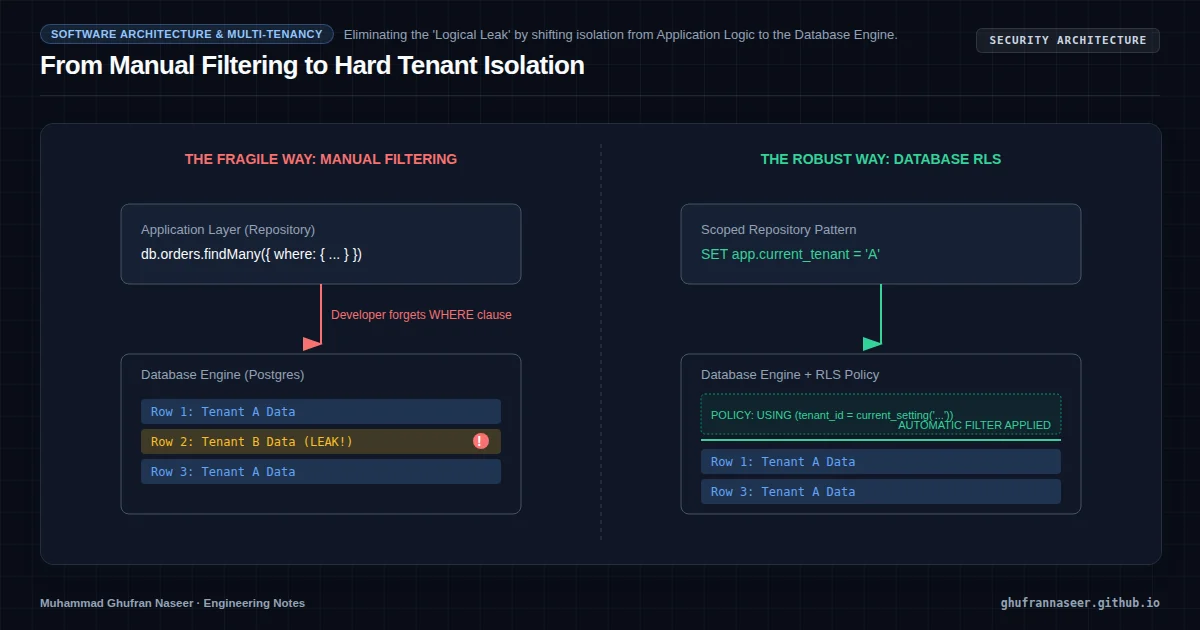
In the transition from simple single-user applications to enterprise-grade SaaS, the 'Modular Monolith' has emerged as a pragmatic middle ground. It offers the deployment simplicity of a monolith with the logical separation of microservices. However, this architecture harbors a critical vulnerability that often goes unnoticed until a customer sees another's data: the Logical Leak.
The Logical Leak occurs when developers rely on manual developer discipline—specifically, the consistent application of a tenant_id filter in every SQL query—to maintain data isolation. In a system with hundreds of tables and dozens of developers, the probability of a developer forgetting a WHERE tenant_id = ? clause in a complex join or a background job is nearly 100%.
The Fragility of Manual Filtering
Consider a standard multi-tenant schema where every table has a tenant_id column. In a typical repository pattern, a fetch request might look like this:
async function getOrders(tenantId: string) {
  return await db.orders.findMany({
    where: { tenantId: tenantId }
  });
}
This looks safe. But what happens during a high-pressure sprint when a developer adds a reporting module? They write a raw SQL query or a complex ORM join to aggregate data across orders, line_items, and inventory. If they miss the tenant constraint on just one of those joins, the database might return a cross-section of data from multiple clients. This isn't just a bug; it's a compliance failure that can end a SaaS business.
Level 1: Database-Level Enforcement (Postgres RLS)
The most robust way to prevent logical leaks is to move the isolation logic out of the application code and into the database engine itself. PostgreSQL’s Row-Level Security (RLS) is the gold standard for this approach. Instead of the application 'asking' for the right data, the database 'refuses' to show anything else.
First, we define a policy on our tables:
ALTER TABLE orders ENABLE ROW LEVEL SECURITY;

CREATE POLICY tenant_isolation_policy ON orders
USING (tenant_id = current_setting('app.current_tenant_id'));
In this model, the application establishes a connection and, before executing any business logic, sets a session variable. This variable acts as a 'security context' for the duration of the transaction:
-- Within a transaction
SET LOCAL app.current_tenant_id = 'tenant_abc_123';
SELECT * FROM orders; -- Automatically filtered by the DB
Even if a developer writes SELECT * FROM orders without a WHERE clause, the database engine transparently injects the filter. This provides a 'fail-safe' default.
Level 2: The Scoped Repository Pattern
While RLS is powerful, it can introduce overhead in connection pooling (since session state must be reset) and can complicate cross-tenant administrative tasks. A complementary approach is the Scoped Repository Pattern at the application layer.
Instead of passing a tenantId as an argument to every function, we use AsyncLocalStorage (in Node.js) or ThreadLocal (in Java/C#) to store the tenant context at the start of a request (usually in middleware). We then wrap our database client in a proxy that automatically injects the tenant filter.
// Pseudocode for a Scoped Database Proxy
class ScopedDb {
  constructor(private baseDb: Database, private context: TenantContext) {}

  query(sql, params) {
    const tenantId = this.context.getTenantId();
    // Automatically append 'AND tenant_id = ?' to the AST or query string
    const securedSql = injectTenantFilter(sql, tenantId);
    return this.baseDb.query(securedSql, params);
  }
}
This ensures that the business logic layer literally cannot access the 'unfiltered' database. It only ever interacts with a 'view' of the data restricted to the current tenant.
The Modular Monolith Boundary Problem
The challenge intensifies when one module needs to trigger an action in another. For example, the Billing module needs to know the Usage stats from the Compute module. In a microservices world, this is a network call. In a modular monolith, it’s often a direct function call or a shared database join.
To prevent boundary leaks, you must enforce Contract-Only Inter-Module Communication. Module A should never query Module B’s tables directly. If Module A needs Module B’s data, it must call Module B’s public API (an internal interface), which is itself scoped to the tenant.
| Isolation Strategy | Pros | Cons |
|---|---|---|
| Manual WHERE Clauses | No setup cost, high performance. | High risk of human error and data leaks. |
| Postgres RLS | Bulletproof enforcement at the engine level. | Complexities with connection pooling and migrations. |
| Scoped Repositories | Easier to test, clear application logic. | Requires strict architectural discipline. |
| Schema-per-tenant | Physical isolation, easiest migrations. | Significant overhead at scale (thousands of tenants). |
Operationalizing Isolation: The "Leak Test"
How do you prove your isolation works? You cannot rely on manual QA. You need Automated Isolation Testing. A standard test suite checks if User A can see User A's data. An isolation test suite explicitly tries to break the system:
- Seed the database with data for
Tenant_AandTenant_B. - Authenticate as
Tenant_A. - Attempt to fetch a specific ID belonging to
Tenant_B. - Assert that the system returns a
404 Not Foundor403 Forbidden, rather than the data.
Conclusion: Defense in Depth
Multi-tenancy is not a feature; it is an architectural constraint. Relying on developers to remember a tenant_id in every query is a strategy that fails as teams grow. The most resilient systems employ Defense in Depth: using Scoped Repositories to guide developers toward the 'pit of success' and Row-Level Security as the final mechanical gatekeeper. By treating tenant boundaries as hard physical constraints rather than soft logical suggestions, you ensure that your modular monolith remains secure, compliant, and ready to scale.